
'Both Modi and Xi know that if all that there is to show for Modi's visit -- barely eight months after Xi's India trip -- is a repeat of the same old declarations, there will be a terrible sense of letdown in the public mood resulting in future summits losing credibility. Only the possibility of new ground being broken can justify Modi's trip at this time,' says B S Raghavan.

If New Delhi finds itself out in the cold in Afghanistan, both the Congress-led UPA and BJP-led NDA have only themselves to blame. Each has been in power for a full decade from 2001, without reaching out to the Taliban, points out Ajai Shukla.

External Affairs Minister Sushma Swaraj on Tuesday flagged off the first batch of pilgrims for Kailash Mansarovar yatra in Tibetan Autonomous Region of China through a new route via Nathu La pass.

Continuing his fast-paced diplomacy, Indian Prime Minister Narendra Modi spoke to China's Premier Li Keqiang on Thursday. During the phone call, Li conveyed his government's desire to establish a robust partnership with the new government in India.

The talks took place over video call on Sunday. According to sources, talks were held for over two hours in a cordial and forward-looking manner.
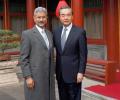
India on Wednesday hit out at China for demanding "solid evidence" for getting Jaish-e-Mohammed chief Masood Azhar banned by the United Nations

Chinese President Xi Jinping arrived in Ahmedabad on Wednesday to a grand welcome. He is India on a three-day visit which will focus on significantly ramping up trade and investment, besides addressing the contentious border issue that has seen occasional flare ups between the two Asian giants.
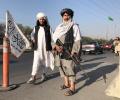
China on Monday expressed the hope that the Taliban will stand by its commitment of establishing an "open and inclusive" Islamic government in Afghanistan and will ensure a peaceful transition of power without violence and terrorism.
The remarks by China's deputy permanent representative to the UN, Geng Shuang, came during an emergency meeting of the Security Council on the situation in Afghanistan on Monday after the sudden and rapid takeover of the Afghanistan government by the Taliban insurgents.
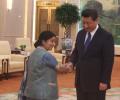
Chinese President Xi Jinping on Monday received External Affairs Minister Sushma Swaraj

The new government needs to clearly insist on diplomatic reciprocal arrangements with China. While reciprocity is a function of power in bilateral relations, the Modi-led government's responses should be based on India'S inherent strengths, says China expert Srikanth Kondapalli.

Special Representatives of India and China will hold the 16th round of boundary talks in Beijing on Friday, the first such meeting under the new Chinese leadership, to make another bid to move forward on the resolution of the vexed dispute.

Afghanistan witnessed a series of terror attacks in the last few weeks as the US aimed to complete the withdrawal of its forces from Afghanistan by August-end, ending a nearly two-decade of its military presence in the war-ravaged country.
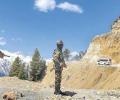
In the next few days, Indian Army will carry out a detailed verification to check actual implementation of the disengagement process, he said. It is learnt that the mutual disengagement in Gogra (patrolling point 17A) is expected to be completed by Thursday.
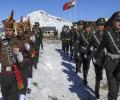
The sources said the mutual disengagement of troops at the two friction points is likely to be completed within two days, and that there has been 'substantial' withdrawal of forces by Chinese military from the areas.

'We should expect a cold-blooded, transactional relation that requires a lot of engagement and mutual trust to sustain,' says Constantino Xavier, Fellow, foreign policy, Brookings India.

India's soft power diplomacy came into play during this cataclysm affecting the world as the pandemic defies barriers and borders, notes Rup Narayan Das.

India's decision to skip the meeting came after a year of bilateral discord over China's stubborn opposition to India's entry into the Nuclear Suppliers' Group and a UN ban against Pakistan-based terrorist group Jaish-e-Mohammed leader Masood Azhar.
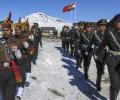
The decision to disengage the forces, locked in a bitter standoff for the last six weeks in eastern Ladakh, was taken at a nearly 11-hour-long meeting between senior Indian and Chinese commanders in Moldo on the Chinese side of the Line of Actual Control (LAC) on Monday.
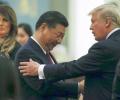
'While many Chinese policy makers dismiss the political, economic and technological component of US-India relations, they express caution on the defence-related ties which also happens to be a major driver in US-India relations,' explains China expert Srikanth Kondapalli.
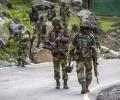
The sources said there was clear sign of withdrawal of structures and troops from the patrolling point 14 in Galwan Valley and that they are likely to move back more than a kilometre in the area.

This is the second time that China has defended the decision to put a technical hold on India's bid to ban Azhar, the mastermind of the January 2 Pathankot terrorist attack.

China said Islamabad is at the frontline of combating terrorism.

Chinese President Xi Jinping arrived in Chennai to a grand welcome on Friday, a visit that comes soon after the recent episode of turbulence in bilateral ties over India's decision to withdraw Jammu and Kashmir's special status and reorganise the state into two union territories.
India has been maintaining that China has no locus standi in commenting on Jammu and Kashmir.

Modi was expected to arrive in Wuhan in the evening on April 26 and join Xi in the informal summit at a picturesque location the next day.

The meeting, which comes after the Doklam standoff, is aimed at a working a new paradigm for the bilateral relations for the next 15 years.

The talks took place in a beach resort in Benaulim on the sidelines of a meeting of the Council of Foreign Ministers of the Shanghai Cooperation Organisation.
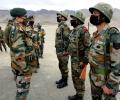
The seventh round of military talks between India and China held on Monday was "positive and constructive", and both sides agreed to earnestly implement the understanding reached by their leaders to not turn differences into disputes, a joint statement by the two armies said on Tuesday.

Jaishankar's talks with Yang and later in the Strategic Dialogue were expected to cover the key India-China differences like China blocking India's bid to join the NSG and UN ban on Azhar.

'From Doklam to Wuhan and the return of the India-China relationship to its previous equilibrium is indeed a major contribution of President Xi and PM Modi. Without any doubt they deserve the kudos for their sagacity and their wisdom,' says Ambassador Gautam Bambawale, India's envoy to China during the Wuhan summit.

52 world leaders, including Narendra Modi, will attend this week's Nuclear Security Summit in Washington, DC. Obama will meet separately only with the Chinese president.

'The virus of trust deficit seems to be taking a toll of the friendship built over the years by succeeding leaderships of the two countries,' notes Rup Narayan Das.

India on Monday voiced its concern to China over its plan to build a multi-billion dollar Economic Corridor to Pakistan through POK, even as it assured Beijing of its commitment to consolidate strategic bilateral ties.

"Rafale's induction in the air force is an important and historical moment and it is a matter of pride for us to be witness to this moment. I congratulate the Armed Forces, and all countrymen on this occasion. The induction of Rafale in IAF's fleet shows the strong relations between India and France. India and France have been economic, cultural and strategic partners since long. Our faith in strong democracy and a wish for world peace are the basis of our relation," Singh said at the induction ceremony being held at the IAF airbase in Ambala.
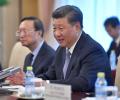
Xi said China is ready to work with Pakistan to forge a closer China-Pakistan community of shared future in the new era.
Swaraj took up the issue with Wang at a bilateral meeting in Moscow on the sidelines of the Russia-India-China trilateral meeting of their foreign ministers.

In a few years there may be 100 Japanese companies in Gujarat, while Chinese firms may commit investments of over Rs 6,000 crore.
India has the ability in all respects to be a great power and address our security challenges in the best national interests, says Commodore Venugopal Menon (retd).

More than India's alignment with the Quad, India's defence cooperation and partnership with the USA is of critical importance, notes Rup Narayan Das.
